The Science
Traditional plastics create major recycling challenges, as breaking them down releases harmful substances. Researchers have developed a promising alternative “circular” plastic that is designed to be broken down into individual monomers that can be reused indefinitely. However, this plastic’s precursors were expensive and not bio-based, and the resulting plastics could not be tailored for specific application needs. For example, plastic used in electronics needs to be hard and stable, while plastic used in packaging needs to be flexible. Researchers engineered microbes to produce a bio-based chemical building block that can help make customizable recyclable plastics. They also used computational screening to predict how different molecular structures of the chemical building block affect the properties and recycling behavior of the resulting plastic.
The Impact
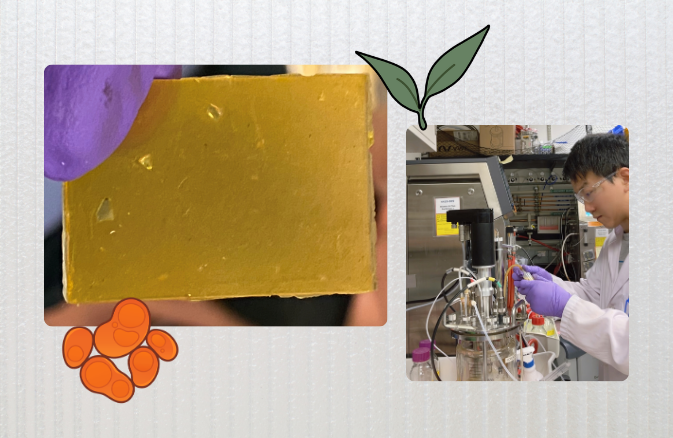
Researchers engineered enzymes that act as molecular assembly lines into microbial hosts. Using this platform, they produced a chemical building block used to make customizable recyclable plastics. This allowed them to access a broad range of these building blocks that could meet different market demands for recyclable plastics. The customizable plastics produced with this method can replace plastics used in electronics, building materials, and more. The building blocks used to make these plastics are affordable, sourced from renewable materials, and can be recovered in pristine quality for reuse. By connecting computational prediction with biosynthetic production, researchers could uncover broader families of recyclable plastics for different applications.
Summary
Polydiketoenamines (PDKs) are a type of recyclable plastic developed by researchers at the Molecular Foundry at Lawrence Berkeley National Laboratory. These plastics can be fully broken down into their individual monomers and reused multiple times. But one big drawback is that it’s difficult to tune their properties for different purposes. β-keto-δ-lactone (BKDL) monomers offer the possibility of creating PDKs with tunable properties. Using a microbial platform to produce BKDLs for different needs is a highly desirable approach, as BKDLs cannot be chemically synthesized in an economically viable way.
Researchers at the Joint BioEnergy Institute demonstrated a method for producing BKDL monomers with diverse properties. The team computationally screened 144 BKDLs, identified solvation free energy (a measure of how a molecule interacts with a liquid) as a key predictor of depolymerization temperature, and experimentally validated selected designs through polymer synthesis and testing. They engineered polyketide synthases (PKSs) — enzymes that act as molecular assembly lines to produce specialized molecules — in microbial hosts. This platform developed BKDL monomers that yielded PDKs that can be tailored to have specific properties. Analyses showed that these monomers, sourced from renewable materials like corn stover, outperform current PDK monomers on cost and emissions. Overall, this research lays the foundation for tailoring the properties of PDKs using BKDL monomers, which are best produced biosynthetically using PKSs.
Publication
Wang, Z., Cheong, S., Wang, H., et al. Engineered polyketide synthases enable a microbial chassis for recyclable plastics with tunable properties. Nature Biotechnology (2026). [DOI: 10.1038/s41587-026-03229-7]