The Department of Energy (DOE)’s Joint BioEnergy Institute (JBEI), led by Lawrence Berkeley National Laboratory (Berkeley Lab), was selected in March 2023 as one of four DOE Bioenergy Research Centers (BRC) to be awarded a combined total of $590 million to support innovative research on biofuels and bioproducts.
The BRC awards kick off JBEI’s fourth five-year funding phase. JBEI and the other centers conduct basic science research to create biofuels and bioproducts from non-food plants. Each BRC has their own distinct research mission and programmatic goals, however, this new funding also specifically earmarks funds for all four BRCs to collaborate together on shared strategic goals.
“We are very excited that the Department of Energy has awarded us with another five years of funding to continue our path-breaking research. This work will enable the cost-effective production of carbon neutral biofuels and carbon negative bioproducts from lignocellulosic biomass. Usage of these fuels and products will reduce the nation’s dependence on fossil fuels while significantly reducing the amount of carbon added to the atmosphere and contamination of the environment.”
– Jay Keasling, JBEI’s Chief Executive Officer
JBEI’s partners include Brookhaven, Pacific Northwest, Lawrence Livermore, Lawrence Berkeley, and Sandia National Laboratories; the Georgia Institute of Technology, Northwestern University, and the University of Adelaide; and the University of California (UC) campuses at Berkeley, Davis, San Diego, and Santa Barbara.
Since its founding fifteen years ago, JBEI research has produced 1,093 peer-reviewed publications, 120 patents, 176 technology licenses, and 12 startup companies. JBEI has long been a leader in establishing technologies that propel the U.S. bioeconomy forward in a competitive market. JBEI has made several significant scientific achievements in its prior funding phase, including:
- Discovery of advanced feedstock agnostic biomass pretreatment solvents, such as ionic liquids and deep eutectic solvents. This included demonstrating a one-pot integrated ionic liquid-based biomass conversion technology that processed mixed woody biomass at a 1500-liter scale, validating the commercial feasibility of the technology by achieving an overall conversion efficiency from biomass to a biofuel of nearly 80%.
- Creating new biosynthetic routes to advanced sustainable fuels for aviation and rocket fuel by harnessing the modular nature of polyketide synthases to develop new biosynthetic pathways that when expressed in bacterial hosts, convert sugars to polycyclopropanated fatty acid methyl ester (POP-FAME).
- Engineering sorghum, switchgrass, and poplar to reduce lignin and other compounds that make them hard to break down while retaining the plants’ health and ability to grow. Some plants have also been engineered to produce value-added compounds that can be used to produce useful products such as renewable polymers and biodegradable plastics.
- Developing a new framework to determine how much accumulation of value-added products in planta compensates for the costs of extraction.
Besides JBEI, the four centers selected include the Center for Bioenergy Innovation led by Oak Ridge National Laboratory; the Great Lakes Bioenergy Research Center, led by the University of Wisconsin-Madison in partnership with Michigan State University; and the Center for Advanced Bioenergy and Bioproducts Innovation, led by the University of Illinois at Urbana-Champaign.
The four BRCs, chosen through a rigorous nationwide competition, will initially receive $27.5 million for fiscal year 2023 with the possibility of additional funding for the next four years of the program cycle.
JBEI is a well-known leader in developing the bioeconomy workforce of the future and partners with many organizations to host students, industry trainees, and postdocs at their Emeryville, CA headquarters. This proximity to the hub of the burgeoning biomanufacturing industry also makes JBEI alumni well-sought after for employment in the field. JBEI also organizes the annual Introductory College Level Experience in Microbiology (iCLEM) – a paid summer science intensive and college preparation program for under-resourced Bay Area high school students.
JBEI History
JBEI was initially established as one of three DOE Bioenergy Research Centers (BRCs) by DOE’s Office of Science in 2007 on the basis of a nationwide competition to accelerate fundamental research breakthroughs for the development of advanced, next-generation biofuels.
Funded at $125 million for its first five-year period, JBEI was officially dedicated on December 2, 2008 at its state-of-the-art laboratory facility in Emeryville. In April 2013, DOE announced a five-year renewal of funding for JBEI at the rate of $25 million annually through 2017.
The other two BRCs that were funded were the BioEnergy Research Center (BESC) led by Oak Ridge National Laboratory, and the Great Lakes Bioenergy Research Center (GLBRC) led by the University of Wisconsin-Madison in partnership with Michigan State University.
The decision to renew the funding for all three BRCs was made following strongly positive evaluations of their respective performances by outside peer review teams. Each BRC has been subjected to rigorous outside evaluation and annual reviews by independent peer review teams.
In ten years of operation, JBEI produced 685 peer-reviewed publications, 273 invention disclosures, 169 patent applications, 89 licenses/options, 28 patents and 6 start-ups.
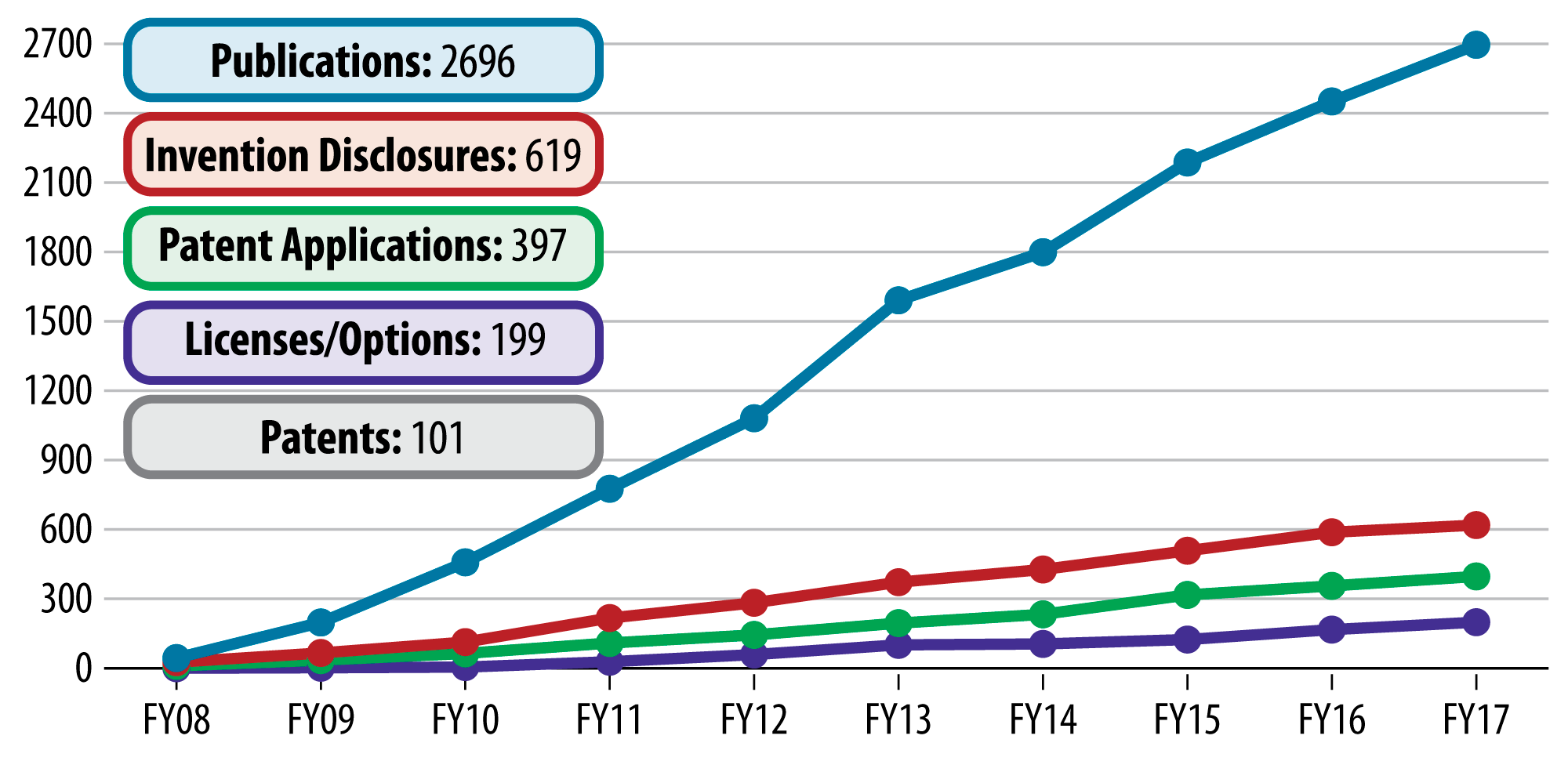
In total the three BRCs have produced 2,696 peer-reviewed publications, 619 invention disclosures, 397 patent applications, 199 licenses/options, 101 patents and 15 start-ups.
DOE’s Office of Science is the single largest supporter of basic research in the physical sciences in the Unites States, and is working to address some of the most pressing challenges of our time. For more information, please visit the Office of Science website at science.energy.gov.
Learn more about DOE’s Bioenergy Research Centers.
Read the DOE Bioenergy Research Centers 2022 Program Update.
JBEI Leaflet